
Products
PRODUCTS Breadcrumb: Home > Products > Industrial Test Instruments > UV Flashlights
 Overview
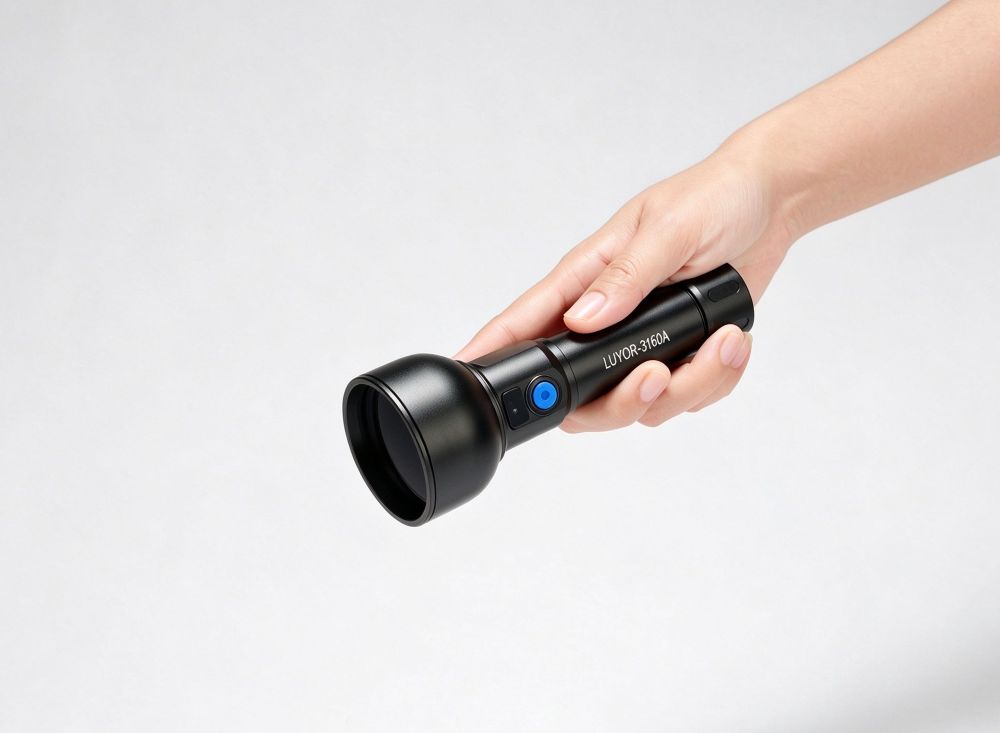
LUYOR-3160A handheld 365 nm UV-A flashlight for fluorescent leak detection: 15,000 uW/cm2 at 38 cm, high and low modes, IP65, two 3500 mAh batteries.
The table groups data by light source, power, mechanical design, and configuration. Irradiance and beam diameter are both quoted at 38 cm (380 mm) from the lamp head; align the measurement distance when you compare intensity with other models.
| Item | Specification | Notes |
|---|---|---|
| Model / brand | LUYOR-3160A / LUYOR | Verify the 3160A nameplate against this page when ordering |
| UV light source | UV-A LED ×3, peak wavelength 365 nm | Spectrum contains no UV-B or UV-C component |
| UV irradiance | 15,000 μW/cm² on high; 4,500 μW/cm² on low | Measured 38 cm from the lamp head |
| Visible light | approx. 14 lux (380–780 nm) | Low stray light; fluorescence contrast is clearer in a dark field |
| Beam | Focused; beam diameter approx. 100 mm at 38 cm | Suited to close-range scanning and spot recheck |
| LED life | approx. 50,000 h | Output decays gradually; recheck periodically with a radiometer |
| Modes / switch | Mid-body switch, high and low | No warm-up; ready when switched on |
| Battery | 3500 mAh lithium battery ×2, 3.7 V | Rotate the two cells with the dual-slot charger |
| Charger | 100–240 VAC adapter, charges both cells at once; car charger supplied separately | Wide input voltage; recharge at the bench or on the road |
| Dimensions / weight | 15 cm long; Ø5.5 cm head; Ø3 cm body; approx. 280 g with battery | One-hand grip for long inspection rounds |
| Protection and environment | IP65 dust-tight; low-temperature operation; immune to magnetic fields | Runs in strong magnetic fields |
The two modes are not simply brighter and dimmer. High mode puts more UV energy on the target surface, which shows weak fluorescence, longer working distances, and incomplete darkening more readily. Low mode cuts output to about 30 percent, so close-up inspection of detail does not wash shallow residue into a bright patch, and it also reduces battery draw and stray reflections from lenses and viewing windows. In practice you scan on low, then switch to high to confirm a suspect point.
Add a fluorescent leak detection dye matched to the medium, run the system for a while, then scan along lines, fittings, and sealing faces with the 3160A. Dye at the leak point is excited by 365 nm and appears as a visible bright spot, which locates even small seeps. Use an oil-soluble dye for oil circuits and a water-based dye for water and cooling systems; do not mix the two.
White light shows dust and scratches; the 3160A shows residue that contains fluorescent material: oil films, varnish, rust-preventive oil, textile lint. Fluorescent material emits visible light under UV, so surface cleanliness moves from hard to see to plainly visible, which suits verification stations before coating, bonding, or display cover glass assembly.
Oil and grease left after cleaning, penetrant from nondestructive testing, and fluorescent tracer powder are easy to miss under ordinary lighting. Scanning the part at a low angle with the 3160A, combined with re-cleaning and a second check, turns a subjective judgement into a recordable inspection result.
Security inks, invisible marks, and phosphor tracers can all be verified under 365 nm excitation. Visible output is low, so the mark stands out against the substrate, which suits sampling checks, position verification, and process demonstrations.
For long-term monitoring of lamp output, add a UV radiometer and re-measure at a fixed distance on a regular schedule, then record the readings in the equipment file. LED output decays gradually, and the eye is poor at noticing that intensity has fallen below the reading threshold.
The three lamp types do not solve the same problem, and the wrong light source causes more misreads than insufficient brightness. The table separates them by what they reveal; most stations keep two or more sources and cross-check.
| Light source | What it reveals | What it misses |
|---|---|---|
| 365 nm UV (LUYOR-3160A) | Oil, varnish, rust-preventive oil, leak detection dye, and tracer powder that contain fluorescent material | Ordinary dust, lint, and shallow scratches with no fluorescent component |
| White inspection lamp | Foreign matter, lint, scratches, chipped edges; broadly applicable | Transparent oil films and light residue with little contrast against the substrate |
| Green inspection lamp (e.g. LUYOR-3360G) | Coarse particles and surface relief; low blue content, so long viewing sessions are less tiring | Chemical residue that requires fluorescent excitation to show |
Switch off strong workplace lighting or draw the blind, and wear the UV protective glasses supplied in the case. The dimmer the ambient light, the easier faint fluorescence separates from the background.
For leak detection, add a dye matched to the system volume and run the system long enough for the medium to reach every fitting; skip this step for surface residue checks.
Hold the lamp about 20-40 cm from the surface, aim at 30-45 degrees, and move in one direction in an S pattern so nothing is skipped by back-and-forth sweeping. Angled light makes the fluorescent boundary of residue clearer.
When a suspect bright spot appears, switch to high and recheck, circle the position with a marker or label, then use white light to establish whether it is real residue or a false signal from reflection or dust.
Re-irradiate after treatment to confirm, and record the position and mode. Before leaving, put the batteries back on the dual-slot charger, wipe the body with a soft cloth, and return the glasses and case to their place.
| Item | Quantity | Remarks |
|---|---|---|
| LUYOR-3160A UV flashlight, main unit | 1 | 365 nm UV-A LED ×3, high and low modes |
| 3500 mAh rechargeable lithium battery | 2 | Swappable in use |
| 100–240 VAC charger | 1 | Charges both batteries at once; car charger supplied separately |
| UV protective glasses | 1 pair | Required for operation; do not substitute ordinary clear glasses |
| Aluminum carrying case | 1 | Stores the unit and accessories for field work |
Check that the nameplate reads LUYOR-3160A: data for a LUYOR-3160 without the A is common online, and its intensity figures and battery configuration are written differently, so specifications and accessories cannot be mixed. Oil-soluble or water-based fluorescent leak detection dye, a UV radiometer, spare batteries, and spare protective glasses can be added to the same order; reference price and stock status follow the information panel on this page and the quotation.
No. The 3160A is a separate configuration: the 15,000 / 4,500 μW/cm² two-mode output, two 3500 mAh batteries, dual-slot charger, and IP65 rating on this page all belong to the 3160A. Online data for the LUYOR-3160 is written differently, so verify the nameplate and the parameters on this page when ordering, and do not mix accessories.
365 nm sits in the UV-A band, and the 3160A spectrum contains no UV-B or UV-C. UV-A still calls for protection: do not look into the lamp head, do not expose skin for long periods, wear the UV glasses supplied with the unit, and avoid directing the beam at other people.
At 38 cm (380 mm) from the lamp head in high mode, where the beam diameter is about 100 mm; low mode gives 4,500 μW/cm². UV intensity changes markedly with distance, so confirm the measurement distance before comparing figures with another model, and use a UV radiometer at the same distance when needed.
Use low mode for wide-area initial scans, close-range detail, overexposure control, or longer runtime; use high mode for confirmation where the dark field is incomplete, the working distance is long, or dye concentration and residue level are low. The usual pattern is a low-mode pass followed by a high-mode recheck of suspect points.
The figures for more than 2 hours of continuous work per battery and about 6-8 hours with two batteries come from different modes and rotation schemes. Plan on about 2 hours of continuous high-mode use; with one cell in the lamp and one on the dual-slot charger, 6-8 hours of work is covered. Actual runtime varies with mode, battery age, and temperature; the manual supplied with the unit takes precedence.
The documentation for this model does not state that charging while in use is supported. The standard package is two batteries plus a charger that fills both at once, which is intended for rotation. For continuous field work, plan a rotation; whether the unit can run from mains is subject to the manual, and you should not modify the power connection.
Match the dye to the medium: oil-soluble fluorescent dye for hydraulic oil, fuel, and gearbox circuits; water-based dye for coolant, water-based hydraulic, and tank systems. After adding it, let the system circulate fully, then scan fittings, sealing faces, and lines with the 3160A; leak points show bright fluorescence.
No. The 3160A works on residue that contains fluorescent material; ordinary dust, lint, and shallow scratches need a white or green inspection lamp. At the station, check form under white or green light, then check residue under UV, and cross-check the two results to avoid a missed call.
IP65 means dust-tight and spray-resistant, not submersible and not rated for pressure washing. Wipe the body with a damp soft cloth, clean fingerprints and oil on the lens with a lens cloth, and keep solvents off the optical surface; switch off and remove the battery before cleaning.
The package contains the main unit, two 3500 mAh rechargeable batteries, one 100–240 VAC charger, one pair of UV protective glasses, and one aluminum carrying case, plus a car charger. Depending on the application, add fluorescent leak detection dye, spare batteries, spare glasses, and a UV radiometer; state the working conditions in your inquiry for an exact list and quotation.
Send inquiry

Email: info@xinysun.com

Tel: 131-2093-6518

Address: 1525 Minqiang Road, Bldg 26, Songjiang, Shanghai

Copyright 2026 Xinysun Instrument (Shanghai) Co., Ltd. All rights reserved.
ICP:ICP-2026046447




 Products
 Applications
 Previous:
 Back to list

 Industrial Test Instruments


