
Products
PRODUCTS Breadcrumb: Home > Products > Industrial Test Instruments > UV Flashlights
 Overview
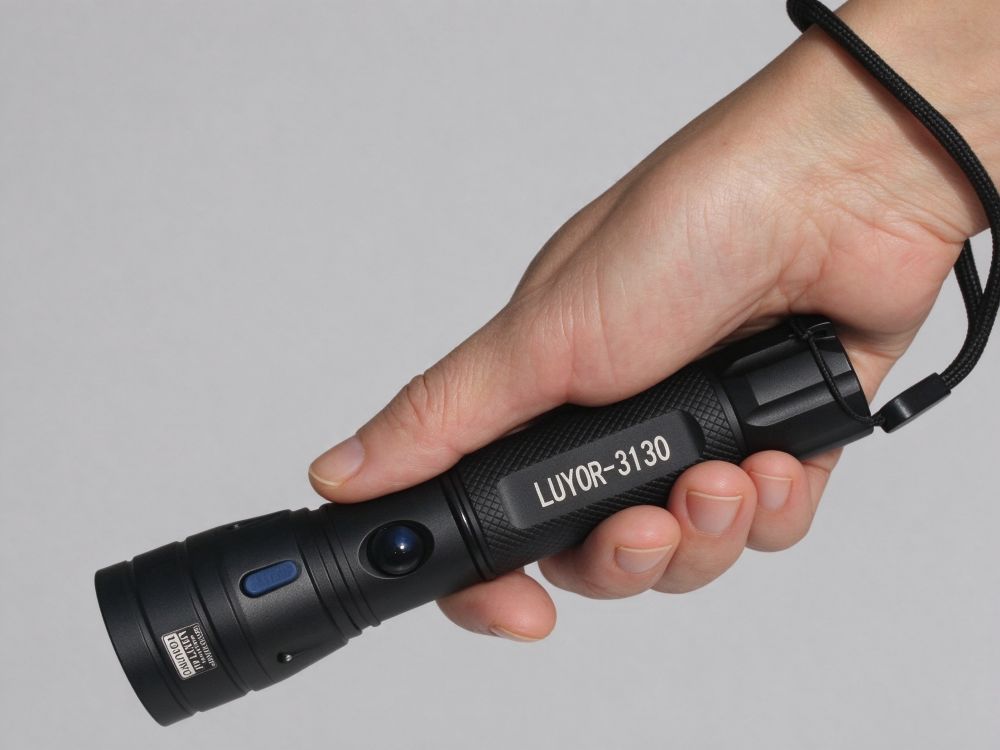
LUYOR-3130 is a 365nm UV-A LED black light flashlight giving 10,000 uW/cm2 at 38 cm and a 63 mm spot, pocket-sized for penetrant, MPI and leak checks.
The LUYOR-3130 flashlight-style black light is a 365nm long-wave UV LED flashlight. Center intensity at 38 cm is about 10,000 μW/cm² and the spot diameter is about 63 mm, enough to cover a weld bead or a pipe joint. It runs on one 18650 lithium-ion cell and weighs about 150 g with the battery, so it slips into a jacket pocket and stays within reach for on-site fluorescence inspection.
The source is pure 365nm long wave, with no short-wave UVB or UVC. LED life is over 50,000 hours, with instant-on output and no warm-up. The side-mounted push button suits one-hand operation. Charging works through a direct cable or a dock charger, and a spare battery is included, giving about 3 hours of continuous work per charge or about 6 hours with two cells in rotation. Typical uses include fluorescent penetrant inspection, fluorescent magnetic particle inspection, riboflavin cleaning validation in pharmaceutical plants, oil and refrigerant leak detection, and particle fallout checks on semiconductor equipment.
Positioning in one line: the 3130 is the "light, bright, ready when you are" portable inspection lamp. For a larger coverage area in handheld wide-area scanning, see LUYOR-365L; for hands-free head-mounted work, see LUYOR-3101S / 3101H; for higher intensity with a diffused field, see the 3104D/3105D series.
| Item | LUYOR-3130 specification |
|---|---|
| Light source type | 365nm UV-A LED (pure long wave, no UVB/UVC) |
| Center wavelength | 365 nm (band 360-370 nm) |
| UV intensity | About 10,000 μW/cm² at 38 cm center (high-output version; instantaneous peak up to 20,000 μW/cm²) |
| Irradiated area | Spot diameter about 63 mm at 38 cm |
| Source life | Over 50,000 hours |
| Visible light leakage | Under 0.4 foot-candles (about 4.3 lux) for the filtered version |
| Battery | Rechargeable 18650 lithium-ion, about 2,200-2,400 mAh |
| Runtime | About 3 hours per cell, about 6 hours with the spare |
| Charging | Direct cable plus two-bay dock (AC/DC) |
| Charge time | About 4-8 hours |
| Dimensions | About 145 mm long, 33 mm diameter |
| Weight | About 150 g including battery |
| Standard package | Flashlight, 2 lithium-ion cells, dock charger, lanyard, holster, UV safety glasses, carry case |
| Compliance | Meets ASTM requirements for UV-A intensity and wavelength in fluorescent penetrant (FPI) and magnetic particle (MPI) inspection |
The figures above are compiled from published manufacturer data. Actual intensity varies with battery charge, lamp-face cleanliness, and measurement position, so treat field readings as authoritative. The high-output version reaches an instantaneous peak of up to 20,000 μW/cm²; about 10,000 μW/cm² is the typical steady-state reference.
Surface-breaking defect detection on aircraft, automotive, and pressure equipment; the flashlight format reaches complex parts and corners easily.
Surface and near-surface defect checks on in-service equipment, welds, and shaft-type parts; a portable source suits scattered points reached by climbing or crawling into tanks.
Riboflavin responds strongly to 365nm, and the 3130 excites bright yellow-green fluorescence from residue on equipment interiors, giving a direct visual check that CIP cleaning has met its limit.
After a fluorescent tracer is applied, trace seepage along lines, fittings, and heat exchangers; hands-free proximity and instant availability speed the search.
Inspect fluorescent particle deposition on tool and chamber surfaces as part of a cleanroom particle control program. See the semiconductor particle inspection topic.
Oil fluoresces under UV, so use that property to check workpiece oil stains and whether kitchen equipment has been fully degreased.
Allow a few minutes in the darkened area for your eyes to adapt. Fluorescence becomes readable after adequate dark adaptation, and skipping it leads to missed indications.
Fingerprints and oil scatter UV and reduce center intensity. Wipe the lens and filter with a lint-free cloth before each use.
The high-output version holds about 10,000 μW/cm² at steady state and falls off quickly as the cell runs down. Charge fully before a long shift and rotate the spare battery.
Coat riboflavin evenly, run CIP per the SOP, dry, then inspect with the 3130. The acceptance criterion is no residual fluorescence. Riboflavin responds to 365nm rather than to purple light, so a black light is required.
Even at long wavelength, wear the supplied UV safety glasses to reduce eye strain over long exposure.
Both fluorescence inspection and cleaning validation depend on "contrast": a dirty lamp face, stray visible light, and unadapted eyes all cause missed indications. Writing lamp-face cleaning, dark-adaptation time, safety glasses, and acceptance criteria into the work instruction is more reliable than chasing higher intensity alone.
Center intensity at 38 cm is about 10,000 μW/cm² (high-output version), with an instantaneous peak of up to 20,000 μW/cm²; about 10,000 μW/cm² is the steady-state reference. Actual values vary with charge, lamp-face cleanliness, and measurement position, so use field readings.
Riboflavin fluoresces strongly under 365nm black light, while a purple light at about 400nm produces no useful response. The 3130 runs 360-370nm with a 365nm peak and is pocket-sized, so it suits the interiors of reactors of different sizes, which makes it a common portable source for riboflavin cleaning validation.
No. The source is pure 365nm long wave with no UVB or UVC, which is easier on the operator and avoids short-wave effects on the surfaces of some test parts.
One 18650 cell gives about 3 hours, or about 6 hours with the spare in rotation. Direct charging and a two-bay dock (AC/DC leads included) are supported, with a charge time of about 4-8 hours. For long storage, keep the cells at about half charge and top them up periodically.
The 3130 is a focused flashlight for close-in, carried inspection and scattered points. Where a larger coverage area and higher intensity are needed, LUYOR-365L and the 3104D/3105D series in our catalog fit better. Choose by "how close you work and how much area you cover" rather than by intensity alone.
The UV-A intensity and wavelength of the 3130 meet the general requirements of ASTM fluorescent penetrant (FPI) and magnetic particle (MPI) inspection. For a specific project, calibrate and record each unit against the minimum intensity and wavelength range in the applicable standard; where needed, step up to the higher-output 3104D/3105D or the BB series.
LUYOR-3130 technical data sheet and operating instructions
Selection notes for riboflavin cleaning validation black lights in pharmaceutical plants
ASTM E3022 black light practice notes and a field record template
Battery, dock charger, and spare accessory list
Xinysun Instruments (Shanghai) supplies LUYOR 365nm UV inspection and leak detection equipment and spares. We can help you choose between the flashlight-format 3130 and a wide-area handheld model for your inspection target and working environment, confirm that intensity and spot size meet the penetrant or cleaning validation standard, and turn the field check into a written work instruction. Send us the part material, the inspection standard, and the site conditions.
Send inquiry

Email: info@xinysun.com

Tel: 131-2093-6518

Address: 1525 Minqiang Road, Bldg 26, Songjiang, Shanghai

Copyright 2026 Xinysun Instrument (Shanghai) Co., Ltd. All rights reserved.
ICP:ICP-2026046447




 Products
 Applications
 Previous:
 Back to list

 Industrial Test Instruments


