
Products
PRODUCTS Breadcrumb: Home > Products > Life Science Instruments > Laboratory UV Lamps
 Overview
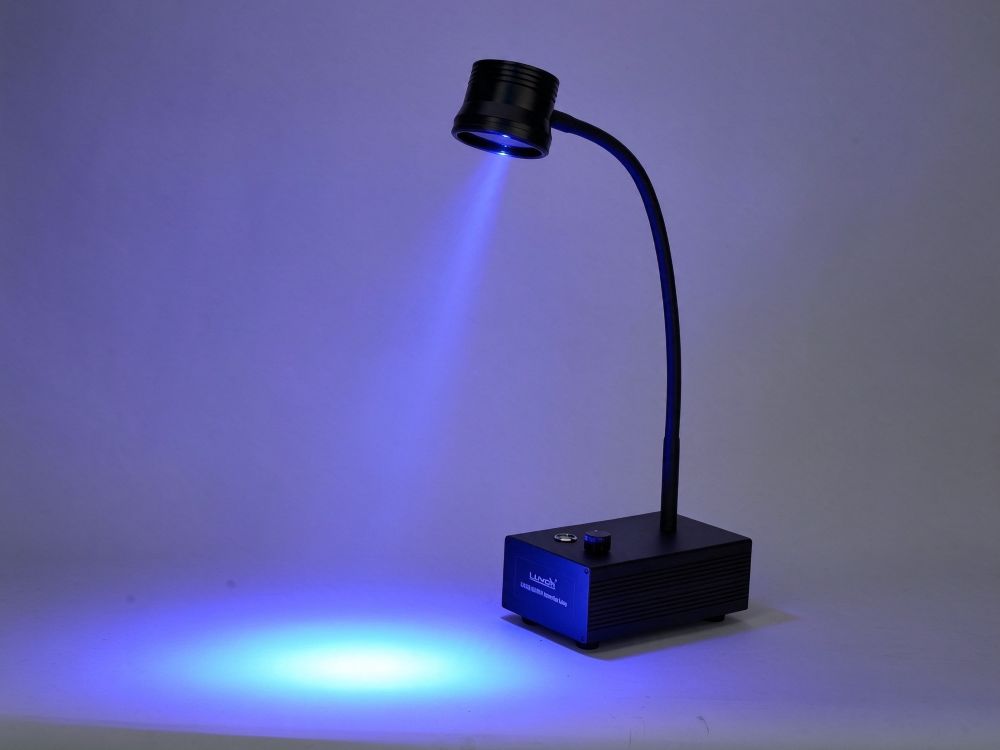
Benchtop 365 nm UV lamp on a 500 mm gooseneck with 19750 uW/cm2 at 38 cm and 10-99.9% dimming, for photocatalysis, UV curing, and fluorescence viewing.
Photocatalysis and photopolymerization experiments typically need a source that stands on the bench, points at the reactor, and runs for hours. A handheld lamp cannot be held that long, and a mercury lamp housing is heavy, hot, and off limits while it runs. LUYOR-3405A is built around that rhythm: the base sits on the bench, a 500 mm flexible gooseneck carries the round head over the reactor, the base knob sets intensity, the lamp lights instantly, and a mid-run angle change needs no realignment of the optical path.
It emits only a narrow 360-370 nm band with a 365 nm peak and no UVB or UVC. For photochemistry, 365 nm is the working band of most photoinitiators and of common photocatalysts (modified TiO₂ systems, g-C₃N₄, and similar), and a narrow band means no spare wavelengths to trigger side reactions; for the operator, the absence of short wave puts it one step lower in risk than a 254 nm model.
It also keeps a capability that is easily overlooked: residual white light below 15 lux at 38 cm. That means it doubles as a benchtop fluorescence viewing lamp - leak detection, TLC plates, mineral samples - with no second blacklight needed.
| Item | Data |
|---|---|
| Model | LUYOR-3405A |
| Source | 20 W high-power UV-A LED |
| Band | 360-370 nm, center wavelength 365 nm, no UVB / UVC |
| UV intensity at 38 cm | 19750 μW/cm² (center) |
| Effective irradiation diameter | About 120 mm (at 38 cm) |
| Dimming range | 10-99.9%, stepless adjustment on the base knob |
| Arm | 500 mm flexible gooseneck, holds at any angle |
| Head diameter | 78 mm, IP65 splash and dust proof |
| Base dimensions | 200 × 130 × 90 mm |
| Unit weight | About 1.7 kg |
| Cooling | Large aluminum alloy barrel, natural convection |
| Head temperature | Not above 60℃ in continuous operation |
| Residual white light | Below 15 lux (at 38 cm) |
| LED life | About 50000 hours |
| Power | External adapter, plug and play |
| Warranty | Three years on the unit (excluding damage from misuse) |
On the different intensity figures: earlier LUYOR Chinese material quoted 8000 μW/cm² at 38 cm and 0.8 kg for the unit, which matches the previous hardware batch; the current 20 W version is listed at 19750 μW/cm² and about 1.7 kg in LUYOR English documentation, and matches the gooseneck bench lamp shown in the product images on this site. Both generations are still in circulation, so state the version you need when ordering, or ask for a radiometer measurement with the shipment.
In a photochemistry experiment the result depends not on how long the lamp ran but on how much energy the sample received. The relationship is one line: dose (J/cm²) = intensity (W/cm²) × time (s). At 19750 μW/cm² at 38 cm (that is 19.75 mW/cm²):
| Target dose | Time needed at 38 cm | Typical scale |
|---|---|---|
| 0.1 J/cm² | About 5 s | Short excitation of fluorescent samples, rapid setting of a spot cure |
| 0.5 J/cm² | About 25 s | Thin photosensitive coatings, small-area spot curing |
| 1 J/cm² | About 51 s | Surface layer initiation in routine photopolymerization |
| 5 J/cm² | About 4 min 15 s | One irradiation cycle in photocatalytic degradation |
| 10 J/cm² | About 8 min 26 s | A single point in light-stability testing of coatings and materials |
| 20 J/cm² | About 17 min | Cumulative dose steps in accelerated aging tests |
Two variables break the assumptions behind that table. The first is distance: an inverse-square estimate for a point source puts 19 cm at about four times the nominal figure, 27 cm at about twice, and 54 cm at about half - but the near-field LED distribution and the head lens both bend the real curve, so measure once at the working position before quantitative work and keep that position for the whole series. The second is the dimming setting: measure the actual intensity at the setting you will use and put that value into the formula, rather than derating the full-power figure.
How to set UV dose in bacterial and cell culture is covered in a separate article: UV irradiation in bacterial and cell culture: band selection and dose calculation.
Dimming is more than turning the lamp down. It turns a fixed source into a variable-intensity source, which serves several kinds of experiment:
| Use | How | Watch for |
|---|---|---|
| Intensity versus reaction rate | Fix the distance, step through 25%, 50%, 75%, and 99.9%, and record the rate for each set of replicates | Measure the mapping from setting to actual intensity first; do not assume it is linear |
| Protecting photosensitive samples from overexposure | Start low, stop when the response appears, then step up | For some photosensitive materials, low intensity for a long time is not equivalent to high intensity for a short time |
| Preventing photobleaching during fluorescence viewing | View at a low setting, then raise it briefly for a photograph or a record | Bleaching of fluorescent proteins and dyes accumulates, so time the viewing setting as well |
| Dose-step experiments | Fix full power and control dose by time, or fix time and control dose by setting | Use one way of controlling the variable within an experiment; do not mix them |
One point to keep in mind: dimming changes the drive current, and the peak wavelength stays largely where it is, but for reactions sensitive to wavelength (a photocatalyst with a narrow absorption band, for example) it is still worth confirming with a filter or a spectral measurement that the output has not shifted after a change of setting.
The effective irradiation diameter at 38 cm is about 120 mm, which covers the lit face of a 90 mm Petri dish or a small beaker. The gooseneck makes fine positioning easy, at the cost of a different spot position each time the bend changes. To keep a series comparable, treat placement as a fixed condition:
Bend the gooseneck so the head faces the sample center at 38 cm, mark the four corners of the base on the bench with a marker, and return the base to the same place every time.
For photocatalysis and dose work, keep the head pointing straight down so intensity is even across the lit face; an angled head stretches the spot and lowers the dose at the edges.
For viewing applications (fluorescence, leak detection) an angle keeps reflected light out of your eyes, but record the angle, because the received intensity is not comparable with vertical irradiation.
φ120 mm covers one Petri dish. To irradiate several replicates at the same dose at the same time, the 250×250 mm square spot of LUYOR-3109 fits better.
The lamp lights instantly with no warm-up, so timing can start at switch-on. Write distance, setting, angle, and duration into the record, and the dose can be recalculated later.
| Application | Key point |
|---|---|
| Photocatalytic degradation (TiO₂, g-C₃N₄, and similar catalysts) | 365 nm is the usual working band; reach dark adsorption equilibrium before switching on, or the degradation curve is not comparable |
| Photopolymerization and UV curing (UV adhesives, photoresists, dental resins) | Fine adjustment of a small spot cure; for large flat areas use a wide-spot model |
| Photodegradation and light-stability testing | Use dimming for an intensity gradient, or a fixed setting with time steps, and include an aluminum-foil dark control |
| Fluorescence viewing (leak detection, thin-layer chromatography, minerals) | Low residual white light keeps the 365 nm background clean in a dark room; view at a low setting to limit bleaching |
| Initial screening of forensic evidence (body fluid stains, fingerprints) | Sweep at an angle and avoid looking into the reflection; mark positive areas before closer examination |
| Photoluminescence and pre-screening of material emission | Fixed benchtop irradiation makes sample-by-sample measurement easy, with the 500 mm gooseneck setting the angle of incidence |
Experiments that need controlled temperature, closed-loop stable output, or several combined bands are better served by a controlled laboratory irradiation system; the advantage of the 3405A is flexibility and immediate use, and the two do not conflict.
The differences between lamps in this range are not in the wattage figure but in spot shape, form factor, and number of bands:
| Model | Bands | Form and spot | Intensity reference | Suited to |
|---|---|---|---|---|
| LUYOR-3405A | 365 nm single-wavelength LED, 20 W | Benchtop gooseneck, φ120 mm round spot, dimmable | 19750 μW/cm² at 38 cm | Single-sample fine irradiation, kinetic studies that need an intensity gradient |
| LUYOR-3109 | 365 nm single wavelength, 9 LEDs | Benchtop, 250×250 mm even square spot | 9000 μW/cm² at 38 cm | Multiwell plates and replicate dishes irradiated at once |
| LUYOR-3410 | 365 nm single-wavelength LED | Handheld or stand, dual use | 6000 μW/cm² at 38 cm | Mobile inspection and on-site irradiation |
| LELMS-38L | 254 / 302 / 365 nm, three tubes | Handheld, 330 mm, three independent switches | 1236 / 848 / 1170 μW/cm² at 10 cm | Several band requirements with low volume each |
| LEAC-280L | 254 + 365 nm, two tubes | Handheld, with a UV-only filter glass | - (center intensity not stated) | Long and short wave only, with an emphasis on fluorescence contrast |
In two sentences: to irradiate one sample with finely controlled conditions, take the 3405A; to irradiate a batch at one dose, take the 3109. A handheld model follows the operator to the work; a benchtop model frees both hands for the sample.
365 nm is UV-A, lower in risk than mid and short wave but not zero. Looking into the head or a reflected spot for a long time still damages the cornea, and skin left in the spot accumulates dose. Do not look down into the head when switching on, use the angle of the beam to keep light away from your line of sight when viewing fluorescence, and wear UV-A safety glasses for long work at close range.
Children and bystanders. A desk-lamp form invites switching on by mistake; when the lab is not in use, switch off the base supply or bend the gooseneck toward the wall.
Liquid splashes. The head is IP65 against splashes and dust, but the power section in the base is not sealed; if reagent spills onto the base, disconnect power before cleaning.
Cooling clearance. The aluminum barrel cools by convection, so do not wrap the head in tissue or foil to block the light - heat builds up and shortens LED life; use a baffle with holes to narrow the spot.
Cleaning. Wipe the head aperture with absolute ethanol and lens tissue; the gooseneck sheath takes a damp cloth, but do not immerse it.
Output checks. LED output declines slowly with accumulated hours and the change is invisible. Measure the intensity at the working position with a radiometer every six months and update the figure in the experimental record.
They correspond to two hardware batches. The earlier Chinese material describes the previous 5-LED version at about 0.8 kg; the current 20 W gooseneck version is listed at 19750 μW/cm² at 38 cm in LUYOR English documentation. Measuring with a radiometer on arrival is the safer route, and we can also measure before shipment and include the data.
No. The 3405A has a single 365 nm band, while nucleic acid crosslinking and sterilization depend on 254 nm short wave. For UVC work see a 254 nm model or a UV crosslinker; the 3405A is intended for photocatalysis, photopolymerization, and 365 nm fluorescence viewing.
The LED is a cold source with no infrared output, and the head stays below 60℃ in continuous operation, far gentler than a mercury lamp housing. Under strong UV over long periods, however, dark or strongly absorbing samples do warm up through light absorption; sensitive systems can run at a lower setting, at a greater distance, or with a fan.
Yes. An LED has no filament and needs no warm-up, and the aluminum barrel supports long continuous operation. Log the accumulated hours and check output with a radiometer at intervals, and replace or downgrade the lamp when output falls past the threshold.
Dimming changes the drive current and leaves the peak wavelength essentially unchanged. For a system with a very narrow absorption band, though, confirm once with a spectrum or a filter before starting the actual experiment.
Yes, and with residual white light below 15 lux the background stays clean in a dark area. Its role is fixed benchtop work; for leak detection where the lamp has to be carried and pushed into gaps in equipment, a handheld blacklight is easier.
If you are not sure which lamp fits, tell us the reaction system, the sample size, and the target dose, and we will check band and spot size with you, or leave a message through contact us.
Send inquiry

Email: info@xinysun.com

Tel: 131-2093-6518

Address: 1525 Minqiang Road, Bldg 26, Songjiang, Shanghai

Copyright 2026 Xinysun Instrument (Shanghai) Co., Ltd. All rights reserved.
ICP:ICP-2026046447




 Products
 Applications
 Previous:
 Back to list

 Industrial Test Instruments


