Products
PRODUCTS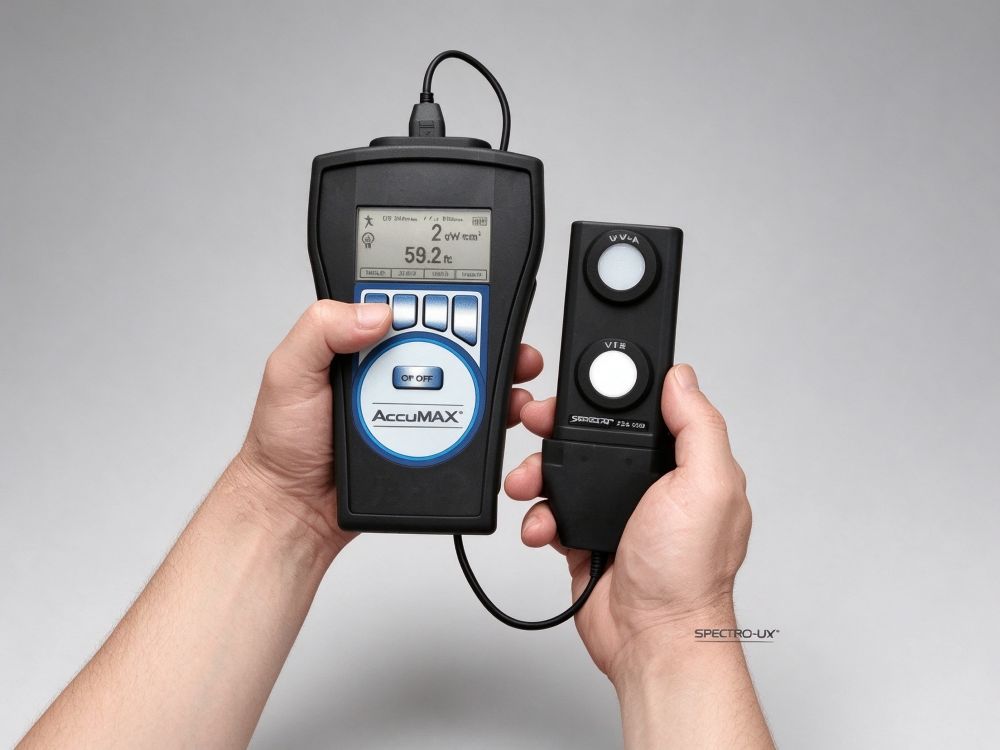
 Overview
XRP-3000 AccuMAX reads UV-A 0-100 mW/cm2 and white light 0-5300 lux on one sensor, and accepts UV-C, UV-B, blue and luminance probes. NIST traceable.
Fluorescent penetrant and magnetic particle reading depends on two numbers at once: enough UV-A irradiance on the part, and little enough white light in the room. XRP-3000 (Spectro-UV AccuMAX) takes both on one dual-wavelength sensor, from one position, in one placement, so the two figures can be compared without arguing about which probe was where. Its XR-1000 readout also accepts UV-C, UV-B, blue and luminance sensors, which is why labs and inspection houses that cover more than one wavelength tend to standardise on this body.
The reading conditions in fluorescent PT and MT are set by two limits acting at the same time. UV-A irradiance on the test surface has to be high enough; ambient white light has to be low enough. Fail either one and contrast drops until indications stop being visible.
The usual field story is a lamp that measures fine while the fluorescence “looks weak”: a bright overhead fixture, a translucent roller door, a window beside the bench. Measure only the black light, see a pass, and the investigation moves on to process and operator causes while the real problem is the room.
XRP-3000 avoids that by collecting both numbers on the same sensor in the same placement. The gain is not extra precision, it is comparability: the same position, the same angle, the same moment.
| Channel | Range | Spectral range | Resolution (auto-ranging) |
|---|---|---|---|
| UV-A irradiance | 0-100 mW/cm² (0-100,000 μW/cm²) | 320-420 nm | 1 μW/cm² from 0 to 9,999 μW/cm²; 0.01 mW/cm² from 10.00 to 99.99 mW/cm² |
| Visible illuminance | 0-5,300 lux (0-500 fc) | 460-675 nm | 0.01 lux from 0 to 29.99; 0.1 lux from 30.0 to 999.9; 1 lux from 1000 to 5300 |
Resolution matters in a darkroom because the background is a few lux, not a few hundred. A meter that only displays whole lux cannot tell 2 lux from 9 lux, so a slow rise in ambient light goes unnoticed until contrast has already gone. At 0.01 lux the change is visible in the record.
| Function | What it does | Where it is used |
|---|---|---|
| ZERO | Sets the current reading as zero and displays relative values | High background, or when the contribution of the lamp alone has to be isolated |
| HOLD | Freezes the reading | One-person work where the sensor cannot be held in place while writing |
| INTG | Integrates UV energy over a set time and shows average intensity | Dose-based work such as curing or exposure checks |
Peak and average intensity, automatic range and unit switching, and a four-language interface sit behind the same four pressure-sensing buttons, which work with gloves on.
| Sensor | Measures | Range and band | Typical use |
|---|---|---|---|
| XDS-1000 | UV-A plus visible light | UV-A 320-420 nm, 0-100 mW/cm²; visible 460-675 nm, 0-5,300 lux | PT and MT lamp intensity plus darkroom white light (supplied in this set) |
| XS-254 | UV-C irradiance | 230-280 nm | 254 nm germicidal and crosslinker lamps |
| XS-300 | UV-B irradiance | 280-320 nm | 302 and 312 nm sources, photobiology work |
| XS-365 | UV-A irradiance | 320-420 nm | Dedicated UV-A channel where white light is measured by another meter |
| XS-450 | Blue irradiance | 420-480 nm | Blue-excited fluorescence processes |
| XS-555/L | Luminance | 0-1,000,000 cd/m², 0-285,000 fL, per ASTM E1742 | Viewing lamps for radiography |
Optional sensors are ordered separately. The readout accepts them without a firmware change, so a lab can add a band later instead of buying a second meter.
| Item | Detail |
|---|---|
| Readout (XR-1000) size and weight | 19.7×10.8×3.2 cm, 360 g |
| Sensor (XDS-1000) size and weight | 12.1×5.1×2.2 cm, 100 g |
| Power | Two 9 V alkaline cells (non-rechargeable), slide-out battery door |
| Sensor connection | Direct to the body, or through a 1.5 m waterproof USB cable |
| Set contents | XR-1000 readout, XDS-1000 sensor, USB cable with adapter, rubber boot, carrying case |
XRP-3000A uses the same readout with the XDS-1000A sensor, which has a 0.5 inch aperture and is stated against ASTM E3022 and ASTM E2297. If your acceptance document names E3022, ask for the A version and send us the clause before ordering.
No. A radiometer reads instantaneous irradiance in μW/cm² or mW/cm²; an energy meter integrates dose in J/cm². Lamp acceptance uses irradiance, curing and crosslinking use dose.
The readout is the same XR-1000. XRP-3000 ships with the XDS-1000 dual-wavelength sensor; XRP-3000A ships with the XDS-1000A, which has a 0.5 inch aperture and is specified for ASTM E3022 and ASTM E2297 acceptance work.
ZERO subtracts the room background so the lamp contribution stands alone; HOLD freezes a reading while you write it down; INTG accumulates UV energy over a set period for dose-based work. Most lamp checks use the plain reading plus HOLD.
Yes, with the XS-555/L luminance sensor, which is stated against ASTM E1742 and covers 0-1,000,000 cd/m². It is not part of the standard set.
The battery door slides out without tools and takes two 9 V alkaline cells. The cells are not rechargeable, so keep a spare set with the case for long site days.
It sets how much the reading drops when light arrives at an angle rather than head-on. A sensor with good cosine response gives a usable number without being squared up to the lamp every time, which is what makes repeated readings by different people comparable.
The sensor housing is sealed with a gasket and the USB connector is waterproof, which keeps light leakage and humidity out. The instrument is still an optical product: no immersion, no condensation, no long storage in high humidity, and wipe it down before it goes back in the case.
Every 6 to 12 months in normal use, and immediately after a drop or a suspicious reading. Send it to an accredited laboratory and keep the certificate with the lamp records; we can arrange the send-in.
Compare all three meters on the UV radiometer range page, or read how to choose a UV radiometer for the geometry and traceability questions that decide a purchase. If you need a blue channel on the same head, look at the XP4000; if you need a wireless probe, look at the Labino Apollo 3.0. Related: six questions on inspection lamp compliance.
Send inquiry

Email: info@xinysun.com

Tel: +86-131-2093-6518

Address: 1525 Minqiang Road, Bldg 26, Songjiang, Shanghai

Copyright 2026 Xinysun Instrument (Shanghai) Co., Ltd. All rights reserved.
ICP:ICP-2026046447
SiteMap | Privacy Policy | FAQ




 Products
 Applications
 Previous:
 Back to list

 Industrial Test Instruments


