
Products
PRODUCTS Breadcrumb: Home > Products > Life Science Instruments > Laboratory UV Lamps
 Overview
ENF-260C and ENF-280C dual-wavelength handheld UV lamps switch between 365 nm UV-A fluorescence and 254 nm UV-C viewing, giving 470 uW/cm2 at 15 cm.
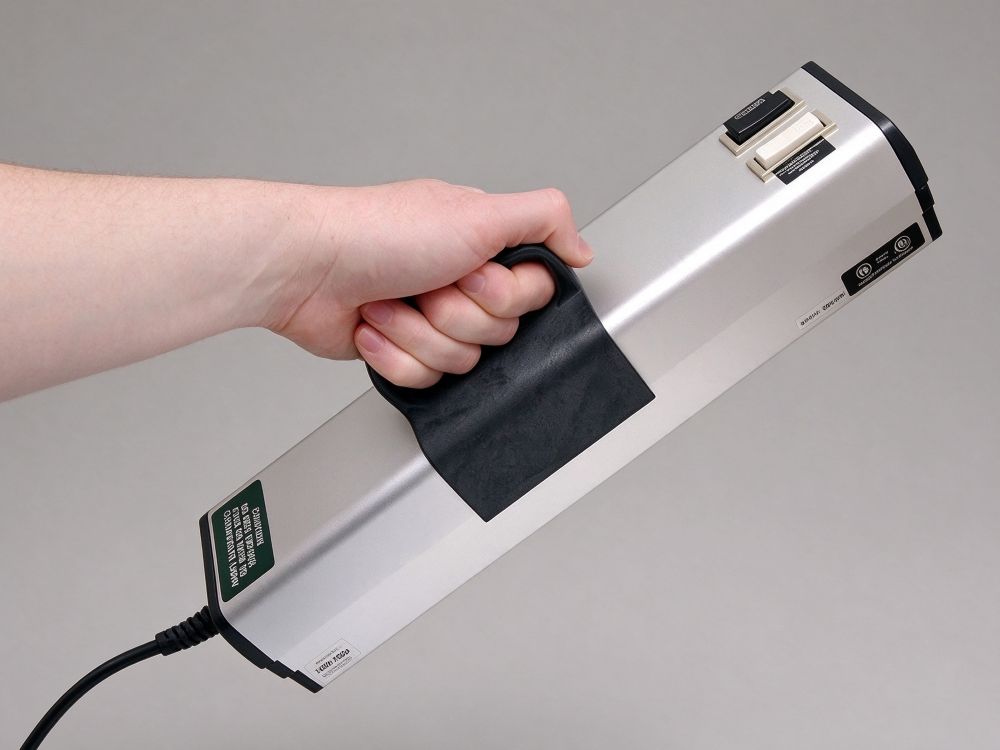
The Spectro-UV (US) E series ENF-260C / ENF-280C is a dual-wavelength handheld UV lamp: a 365nm (UV-A) tube and a 254nm (UV-C) tube sit side by side in the body, the light passes through a filter assembly, and a toggle switch selects the wavelength. The 365nm longwave excites fluorescence, and the 254nm shortwave serves shortwave viewing and germicidal irradiation, so one lamp covers two routine inspection tasks.
The two models differ in tube power and body length: the ENF-260C uses twin 6 W tubes, with a 26cm body and a weight of 1.77kg; the ENF-280C uses twin 8 W tubes, with a 33.65cm body, a weight of 0.72kg, and higher UV output. The housing is silver anodized aluminum with an ergonomic carrying handle and LongLife filter glass, which resists solarization and extends the working life of the lamp.
The positioning in one sentence: the E series is the "classic twin-tube handheld lamp" tier - quartz tubes give a pure UV line spectrum, the structure is simple, and the lamp lasts. It is handy for routine TLC viewing and fluorescence marker checks; where higher fluorescence excitation intensity or three wavelengths are needed, compare the high-intensity models on this site such as LUYOR-3410.
| Item | ENF-260C | ENF-280C |
|---|---|---|
| Light source | 6 W 365nm tube + 6 W 254nm tube (with filter assembly) | 8 W 365nm tube + 8 W 254nm tube (with filter assembly) |
| Typical peak intensity (about 15 cm) | UV-A about 350 μW/cm²; UV-C about 390 μW/cm² | UV-A about 470 μW/cm²; UV-C about 500 μW/cm² |
| Length | 10.25 in (26.04cm) | 13.25 in (33.65cm) |
| Width | 3.25 in (8.26cm) | 3.25 in (8.26cm) |
| Height | 2.5 in (6.35cm) | 2.5 in (6.35cm) |
| Weight | 3.9 lb (about 1.77kg) | 1.6 lb (about 0.72kg) |
| Housing | Silver anodized aluminum | Silver anodized aluminum |
| Filter glass | LongLife filter glass | LongLife filter glass |
| Switch / handle | Toggle switch + ergonomic handle | Toggle switch + ergonomic handle |
| Plug version | /FC China (Type I) and other versions | /FC China (Type I) and other versions |
| Lamp type | Handheld | Handheld |
Intensity figures are the manufacturer's typical values at about 15 cm; actual readings vary with tube condition and distance. The China plug version carries the /FC suffix, and US, UK, EU, JP, and AU versions are also available - choose by the country of use when ordering.
One wavelength shows longwave fluorescent spots and the other shows the shortwave fluorescence-quenching background, so one plate can be read two ways without changing lamps.
Quick initial checks of fluorescent markers, alterations, and anti-counterfeit features, with the shortwave mode for trace contrast.
Fluorescent contamination and residue checks on bench tops and vessel surfaces, alongside visual screening.
Routine work such as fluorescence location before gel excision and confirmation of fluorescent sample labeling.
Longwave and shortwave fluorescence response is a common observation axis in gem identification, and one dual-wavelength lamp allows the comparison.
Simple and robust, suited to laboratory teaching, mobile testing, and third-party site work.
| Item | ENF-240C | ENF-260C | ENF-280C |
|---|---|---|---|
| Tube | 4 W 365nm + 4 W 254nm | 6 W 365nm + 6 W 254nm | 8 W 365nm + 8 W 254nm |
| Length | 8 in (20.32cm) | 10.25 in (26.04cm) | 13.25 in (33.65cm) |
| Weight | 2.82 lb (1.28kg) | 3.9 lb (1.77kg) | 1.6 lb (0.72kg) |
| Suitable for | Budget-sensitive, close-range small-area viewing | Routine daily laboratory inspection | Higher excitation intensity, faster viewing |
The same series also includes the EA-140 / EA-160 single-wavelength 365nm (UV-A) models for users who need the longwave mode alone; where a shortwave mode or switching between the two is needed, choose from the ENF series by power. The standard domestic supply version is the China plug /FC.
The wavelengths and functions are the same; the difference is tube power (6 W versus 8 W) and output intensity (UV-A about 350 versus 470 μW/cm²). The 260C is sufficient for routine TLC and initial fluorescence screening; choose the 280C when sample fluorescence is weak, the viewing load is heavy, or higher contrast is needed. Note that the 280C has a longer body yet weighs less.
Shortwave UV carries a risk of eye and skin injury. Wear UV safety glasses when viewing, avoid looking into the source, and avoid prolonged exposure of skin; do not leave samples exposed for long periods, because 254nm irradiation damages nucleic acid samples - keep exposure as short as possible when excising gels for recovery.
Check that the 365nm mode is selected rather than the 254nm mode; then check the filter surface for dust and fingerprints, which lower transmission noticeably; then consider the fluorescence quantum yield of the sample itself. Where higher excitation intensity is genuinely needed, step up to the 8 W ENF-280C, or look at a high-intensity handheld lamp such as LUYOR-3410 on this site.
The 254nm mode can irradiate bench items briefly, but the E series is an inspection lamp, not dedicated disinfection equipment: an ozone-free tube acts on the surfaces it reaches, has no effect in shadows, and should not be run for long periods with people present. Laboratories with systematic disinfection needs should use dedicated UV disinfection equipment (such as the XX-15/XX-20 tube UV lamps).
Quartz tubes give a narrow, pure UV line spectrum, and 254nm is a band that LED arrays find hard to deliver consistently; filtered fluorescence contrast is stable, and tube replacement is inexpensive. LED handheld lamps (such as LEAC-280L and LELMS-38L) offer instant start, shock resistance, and no warm-up. Choose by working habit and budget; either handles routine inspection.
E series tubes are standard 4/6/8 W double-pin UV tubes, and one end unscrews for user replacement; the 365nm mode uses a BLB blacklight tube and the 254nm mode a germicidal shortwave tube, so buy by model and do not mix them. The LongLife filter glass needs no periodic replacement; contact service if it fogs noticeably.
E series product brochure and manual
ENF-240C / 260C / 280C selection comparison chart
Replacement tube and accessory list
Xinysun Instruments (Shanghai) supplies Spectro-UV (Spectroline) E series handheld UV lamps and tube accessories. We can help you select by inspection target and viewing distance, confirm the plug version and replacement tube stock; send us your application and we will take it from there.
If you are comparing the ENF-280C, it is worth looking at our LUYOR LEAC-280L. Both are 254nm plus 365nm dual-wavelength handheld UV lamps covering fluorescence excitation and shortwave viewing, but the technology paths differ:
Put simply: for classic quartz tubes, replaceable tubes, and spectral purity, take the ENF-280C; for LED instant start, low maintenance, and field mobility, look at the LEAC-280L. Wavelength coverage is the same, so decide by working habit and budget. Send us your inspection target and we will help you judge which one fits better.
Send inquiry

Email: info@xinysun.com

Tel: 131-2093-6518

Address: 1525 Minqiang Road, Bldg 26, Songjiang, Shanghai

Copyright 2026 Xinysun Instrument (Shanghai) Co., Ltd. All rights reserved.
ICP:ICP-2026046447




 Products
 Applications
 Previous:
 Back to list

 Industrial Test Instruments


