Products
PRODUCTS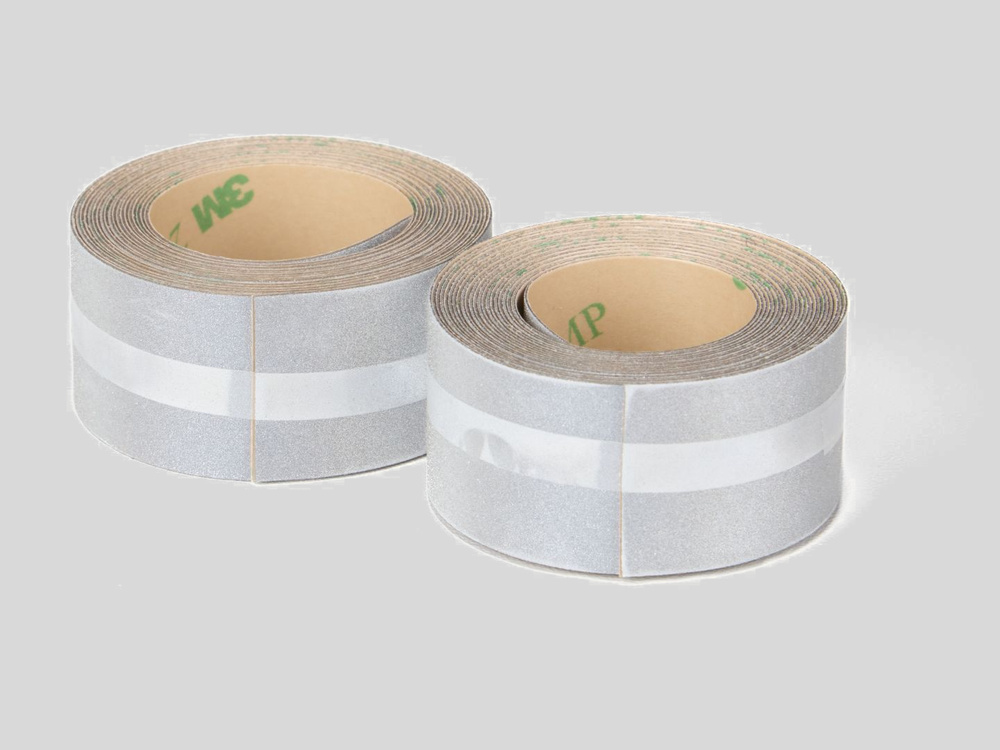
 Overview
LUYOR HTRT high-temperature reflective tape offers 480 cd/(lx m2) return, 120 degrees C continuous and 200 degrees C for up to one hour. Available as 20 mm x 2 m or 5 m rolls for engines, turbines and dryers.
Reflective tape is a stack of glass-bead return layer, pressure-sensitive adhesive and release liner. As temperature rises, ordinary adhesive softens initially and centrifugal force shifts the mark. A little more heat shrinks the backing and wrinkles the reflective face, scattering the return light. In the field the readings become intermittent or jump. HTRT changes both the adhesive system and the backing while keeping a high reflection coefficient across a -40 to 200 degrees C range.
| Condition | Standard tape behaviour | HTRT capability |
|---|---|---|
| Continuous 100 degrees C plus | Adhesive softens, edges lift, readings drift | Stable at 120 degrees C continuous |
| Brief exposure near 200 degrees C | Backing shrinks, reflective face wrinkles, tape detaches | Short-term 200 degrees C rating, one hour maximum |
| -40 degrees C cold stores or outdoor | Backing becomes brittle and cracks on curves | Flexible at -40 degrees C |
| High-speed rotation | Adhesive creeps and pulse amplitude varies | 10-11.3 N/cm peel strength after cure |
| Item | Specification |
|---|---|
| Model | LUYOR-HTRT |
| Formats | HTRT-2: 20 mm x 2 m; HTRT-5: 20 mm x 5 m; one roll per pack |
| Reflection coefficient | 480 cd/(lx m2) |
| Operating range | -40 degrees C to +200 degrees C |
| Continuous temperature | 120 degrees C |
| Short-term temperature | 200 degrees C, up to one hour |
| Peel strength | 10-11.3 N/cm, 90 degrees, 23 degrees C, 300 mm/min, 72 h cure, steel |
| Shelf life | 24 months at 16-27 degrees C and 40-60% RH |
Crankshaft and camshaft ends, turbochargers and turbine shafts, where heat and speed combine.
Short-term hot conditions up to 200 degrees C for test-bench and temporary speed checks.
Rollers running above 100 degrees C for long periods are within the 120 degrees C continuous rating.
Flexible down to -40 degrees C for cold stores, outdoor fans and low-temperature tests.
Clean and degrease the mounting surface, wipe with isopropyl alcohol and let it evaporate fully before applying. Solvent residue directly affects adhesion at temperature.
Supplied 20 mm wide in rolls. Cut to suit the optical spot and working distance. One mark per revolution keeps the reading straightforward.
Press from the centre towards the edges. On curved surfaces, work along the arc so no pockets remain.
The stated peel strength is reached after 72 hours. If you must measure sooner, press firmly and avoid immediate high-temperature, high-speed operation.
Confirm the reading at ambient temperature, then repeat at the operating temperature. If signal strength falls, check the edges for lift.
The stated rating is no more than one hour. For sustained running near 200 degrees C use a hall-effect gear sensor or another non-tape method. Tape is not suitable for long-term extreme heat.
Clean and degrease the surface, wipe with isopropyl alcohol and let it dry fully. Then apply the tape and let it cure. The stated peel strength is reached after 72 hours; if you need to measure sooner, press firmly to remove air.
Do not mix different tape types at the same measurement point. Different return strength makes pulse amplitude uneven. Use one tape type and a single mark per point.
Keep it in the original pack at 16-27 degrees C and 40-60% RH. Shelf life is 24 months. Avoid hot equipment and direct sunlight, which age the adhesive early.
For normal temperature speed checks use RT12 pre-cut tabs or RT10/RT20 roll tape. Choose HTRT when the mounting area stays above 100 degrees C or briefly reaches 200 degrees C. For multiple pulses per turn use zebra tape.
Send inquiry

Email: info@xinysun.com

Tel: +86-131-2093-6518

Address: 1525 Minqiang Road, Bldg 26, Songjiang, Shanghai

Copyright 2026 Xinysun Instrument (Shanghai) Co., Ltd. All rights reserved.
ICP:ICP-2026046447




 Products
 Applications
 Previous:
 Back to list

 Industrial Test Instruments


