Products
PRODUCTS Breadcrumb: Home > Products > Life Science Instruments > Laboratory UV Lamps
 Overview
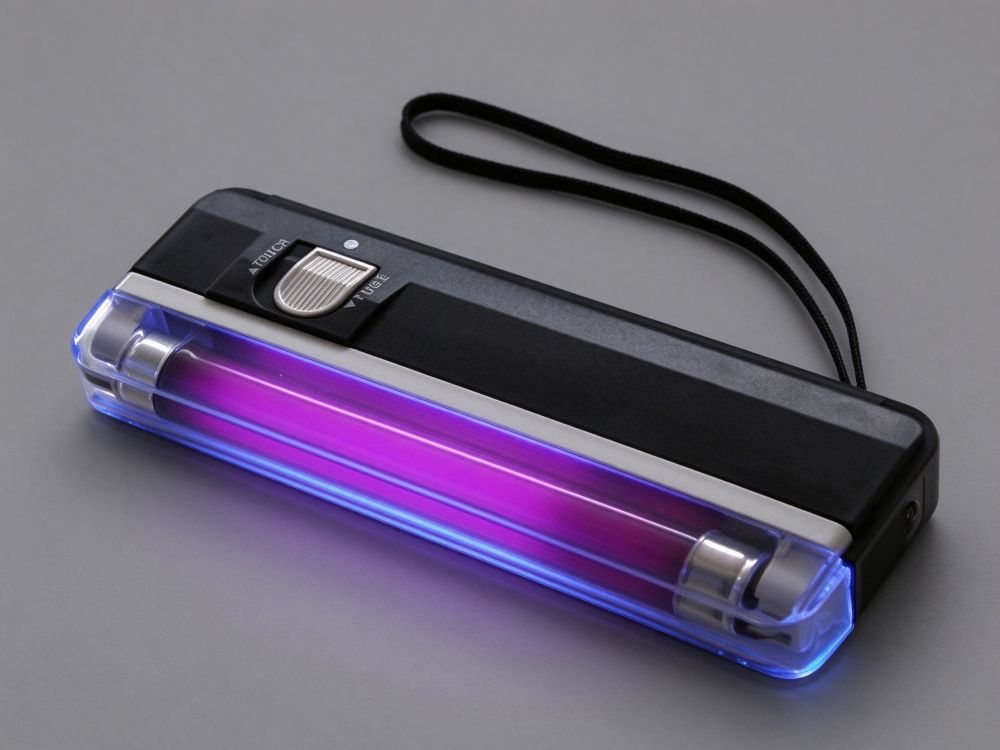
LUYOR LUV-4B pocket UV lamp: 4W 365nm self-filtering tube, 198 g, four AA cells, 4-6 hours runtime, LED white light for banknote, ID, and mineral checks.
A UV lamp that fits in a shirt pocket - 15.9 cm long, 198 g, running on four AA cells, and worn on the wrist with the supplied nylon strap. That is the shape of the LUYOR LUV-4B handheld mini UV lamp: a 4 W 365 nm long-wave self-filtering tube, an LED white-light illuminator, and a slide cover that lets you change tube and batteries without tools.
It is not built for large-area industrial inspection. It solves a narrower problem: you need to go on site, the target is small, and you want to see the result at once. Banknotes, ID documents, mineral specimens, antiques and paintings, pet stains - what these have in common is that the reading depends on the fluorescence response itself. They do not need a wide beam; they need a lamp that lives in a bag and lights up when pulled out.
At this price point there are two routes, LED and tube, with different reading performance and handling. LUV-4B takes the tube route, and that is the point to confirm when specifying.
Source: 4 W low-pressure mercury vapor discharge tube, twin-bore design with both electrodes at one end. The tube wall is self-filtering - it acts as the filter, so visible light outside 365 nm is blocked and the output is mainly long-wave UV;
Wavelength: 365 nm peak. Fluorescent security features, inherent mineral and gem fluorescence, and UV-excited residues can all be read;
Start-up: lights at switch-on, with no warm-up to reach full intensity. That matters for quick reading on site - traditional high-pressure mercury lamps need several minutes of warm-up, and waiting for a lamp to heat up rarely works in the field;
Power: four 1.5 V standard AA alkaline cells (not included), about 4-6 hours of continuous use. AA cells are available anywhere, so no dedicated charger is needed;
Illumination: LED white light. In a dark room you can inspect the surface structure and position the lamp under white light, then switch to UV to see the fluorescence difference;
Construction: ultralight ABS and nylon housing with a textured grip and plastic screws (no tools for tube changes), a slide cover for battery changes, and a nylon wrist strap in the box.
| Item | Specification | Notes |
|---|---|---|
| Model | LUV-4B | LUYOR handheld mini UV lamp |
| Spectral range | 365 nm long-wave UV (UV-A) | Peak wavelength 365 nm, long-wave band |
| Lamp type | 4 W self-filtering long-wave UV tube | Low-pressure mercury vapor discharge tube, twin-bore, both electrodes at one end |
| Dimensions | 15.9 × 5.1 × 2.5 cm | About 6.25 × 2 × 1 in, fits a shirt pocket |
| Weight | 198 g (about 7 oz) | Weight including batteries |
| Power supply | 4 × 1.5 V AA alkaline cells | Batteries not included |
| Continuous operation | About 4-6 hours | Continuous runtime |
| Auxiliary light | LED white light | Aids positioning and surface inspection in dark rooms |
| Construction and controls | Slide cover for battery changes; textured housing and plastic screws for tool-free tube changes | ABS and nylon housing, nylon wrist strap supplied |
| Start-up | Lights at switch-on, no warm-up | Single-button operation |
| Spare parts | 6 in BLB long-wave tube | Replacement tube available as an option |
Fluorescence inspection covers more ground than most people expect. This pocket lamp covers the quick-check end of it:
| Scenario | What you look at | How to use it |
|---|---|---|
| Banknote and ID checks | Fluorescence color of the security strip embedded in paper currency (different denominations show different colors), hidden security marks on credit cards, fluorescent-ink stamps | Illuminate in a dark or shaded place and compare against a known genuine note; genuine strips show a specific fluorescence, while forgeries and photocopies glow across the whole surface with no structure |
| Mineral and gem identification | Inherent fluorescence color and intensity of minerals and gems | Make a preliminary discrimination from the inherent fluorescence of the sample; side-by-side comparison of similar samples is more reliable |
| Antiques, paintings, and art | Surface fluorescence differences that reveal overpainting, later alterations, stains, and aging | Fluorescence differences on paintings, ceramics, glassware, and textiles can indicate repair and refinishing |
| Pet stains and pest location | Fluorescence from protein metabolites in pet urine | Low-power UV needs close range and dim ambient light; mark and treat findings with a suitable cleaner |
| GFP screening | Cells or extracts expressing green fluorescent protein | GFP appears bright green under 365 nm excitation and can be used for transgenic screening; for the method see GFP fluorescence screening |
| Quality control and outgoing inspection | Integrity of coatings, seals, labels, and fluorescent markings | Quick spot checks on the line, one person with one lamp |
| Document authenticity and alterations | Fluorescent security features on IDs and documents; erased, altered, or retouched paper texture | Whether the fluorescent features are intact and match the original |
For large-area scanning of industrial equipment surfaces, riboflavin cleaning verification, or inorganic particle checks, use LUYOR-365L, MNT-365A, and the biofilm inspection lamp series instead; for the methodology see how to use a UV inspection lamp correctly.
Fluorescence reading has one hard rule: the meaning of a bright spot is defined by a reference sample. With a 4 W tube, the following points matter even more:
Dim the room before you read. Low-power UV is nearly useless under ambient light, so switch off the lights, close the blinds, or use a blackout cloth before reading;
Work close to the target. 4 W is low power, so the lamp must be near the part; at too great a distance the fluorescence response falls below what the eye can see;
Locate with white light, then read under UV. The built-in LED white light is there for this: see the surface structure and the target position, then switch to UV;
Hold distance and angle constant for comparison. Shine the lamp on a sample known to fluoresce (a leak-detection dye or a security sample) before you read the part, so you know what "bright" means for your material and sample;
Keep conclusions conservative. A UV lamp gives a lead that a location deserves re-inspection, not a statement of composition and not a release decision;
Protect your eyes. 365 nm is long-wave UV, but staring at the lamp or its reflected light for long periods still causes discomfort; wear UV safety glasses and do not look into the tube;
Log tube degradation. The output of a tube-based lamp falls with hours of use. Measure it with a UV radiometer at intervals and record the result in your log - this is the key to making acceptance recordable.
Each route has its trade-offs. A 4 W tube lamp such as LUV-4B offers a low price, instant start, and simple construction; the limits are weak output, the need to work close to the target in a dimmed room, and a tube with a finite life that needs periodic replacement. LED models (on this site LUYOR-365L and LUYOR-3410) give far higher output, a larger spot, and no lamp maintenance, at a higher price and in a larger, heavier body. The criterion is simple: if the targets are a few small items, the lamp must fit in a pocket, and a quick look is all you need, choose LUV-4B; if you need to scan a whole surface, read weak fluorescence, or work continuously, choose an LED model.
That depends on three things: the distance to the target, how dark the ambient light is, and the fluorescence intensity of the target itself. Close up and in a dark room, low-power UV reads without difficulty; at a distance or in brighter surroundings, the fluorescence response falls below what you can see. The rule for using it is close and dim, not expecting it to replace a high-power unit. For batch scanning or weak residue reading, use an LED model.
These are bands for different purposes. 365 nm is long-wave UV (UV-A), used for everyday handheld observation and fluorescence reading, with a wider margin of safety and a broader range of applications; 254 nm is short-wave UV (UV-C), with a markedly higher harmful radiation risk, and is used mainly for disinfection and specific industrial work, not for routine handheld reading. The sister model LUV-4C on this site is the 254 nm version, so check the band when ordering.
No. The slide cover and plastic screws make tube changes tool-free, and a 6 in BLB long-wave tube can be ordered separately. The tube is a wear part, so check output at intervals based on operating hours and keep a spare; this site also offers XX-15/XX-20 tube UV lamps and similar tube models for comparison.
For everyday fluorescence observation, yes; for a formal accept/reject decision, no. Fluorescent penetrant and magnetic particle inspection carry defined requirements for irradiance, uniformity, and acceptance criteria (the ASTM E3022 family and related standards), and call for compliant high-power equipment at a fixed station, with reading performed by qualified personnel; for equipment and standards see UV-A lamp selection for aerospace NDT and choosing a fluorescent inspection lamp. LUV-4B is positioned for quick observation and preliminary screening on site.
The lamp itself can be carried in, but keep two things apart. One is whether the body suits a clean area: a plastic and nylon housing collects less debris than a knurled metal barrel, but it should still go through the pass-through procedure of the room. The other is that cleanroom surface checks more often use dedicated fluorescence leak-detection and biofilm inspection equipment - MNT-365A has a one-piece smooth body that does not shed particles, and the biofilm inspection lamp series targets bacterial, yeast, and mold residue; the objects of reading differ.
A nylon wrist strap is standard; AA cells are not included, so bring a spare alkaline cell. A 6 in BLB long-wave tube is available as a spare. For eye protection we suggest LUV-10 series UV safety glasses; if you also need to measure tube output, add a UV radiometer.
Send inquiry

Email: info@xinysun.com

Tel: 131-2093-6518

Address: 1525 Minqiang Road, Bldg 26, Songjiang, Shanghai

Copyright 2026 Xinysun Instrument (Shanghai) Co., Ltd. All rights reserved.
ICP:ICP-2026046447



 Products
 Applications
 Previous:
 Back to list

 Industrial Test Instruments


